- front page
- Investment and wealth management
- invest
- Recommended Books for Stock Investing Beginners | 5 Introductory Books You Can Understand Even If You're a Beginner
Recommended Books for Stock Investing Beginners | 5 Introductory Books You Can Understand Even If You're a Beginner
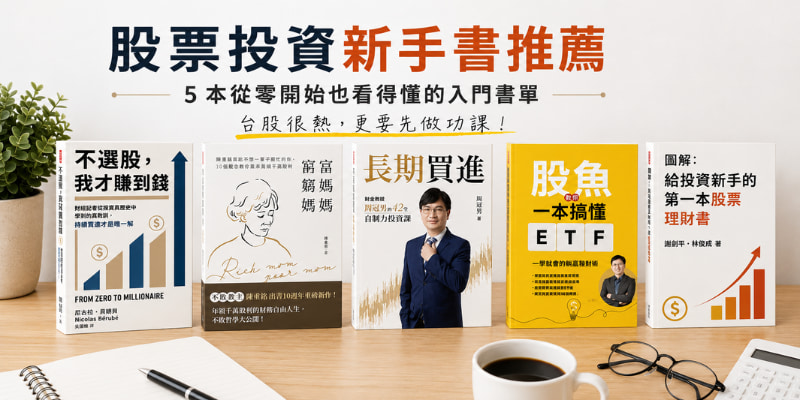
You might also have this feeling:
"Everyone seems to be making money, should I get involved too?"
"If I don't buy it now, will it be more expensive later?"
A friend said a certain stock is performing very well; should I consider buying it?
"Would it be too slow if I only buy ETFs?"
This feeling is normal. Especially when the Taiwan stock market hits new highs and the market atmosphere is very hot, novices are most easily driven by anxiety: the fear that if they don't buy now, they will miss out on this wave of market gains. For example, on May 5, 2026, the Taiwan Stock Exchange Weighted Index set new records both intraday and at the close, closing at 40,769.29 points, with trading volume approaching NT$1 trillion. This kind of market atmosphere can easily put pressure on beginners to "should I hurry up and enter the market?" But I sincerely believe that the more this happens, the less novice investors should rush to place orders.
The most dangerous thing about investing isn't that you haven't bought any stocks yet, but that you've already thrown money into the market without knowing what you're buying. Seeing others make money and buying in line, hearing insider tips and rushing to buy, assuming high dividends are a sure thing – these are where many beginners most easily pay their dues. Therefore, this article isn't recommending books that promise "you'll catch soaring stocks," "quickly double your money," or "get rich quick."
How to choose a book for stock investment beginners? I would first eliminate books that are too hard, too exciting, or too old-fashioned.
There are many books on investing, but not all are suitable for beginners. Some are classics, but their content is too dry, making it feel like reading a textbook for those just starting out in stocks. Some books are exciting, but they overemphasize short-term trading, soaring stocks, and doubling your money, easily misleading novices into thinking that investing is just a game of who has the most courage. Some books are very famous, but they are quite old and may not be as relevant to current investment scenarios such as ETFs, high-dividend stocks, and regular fixed-amount investments. Therefore, I will use three criteria to select this list of books:
First, it must be understandable for beginners . It's not just about recommending books that experts think are good, but about making sure that even people who have never touched stocks can read it.
Second, the right mindset is essential . Don't encourage chasing high prices, don't blindly follow insider tips, don't portray investing as gambling, and don't let beginners believe that high returns come without risk.
Third, the book list should have recent discussion or sales visibility . This list is in response to the recent surge in the Taiwan stock market, which has prompted beginners to start buying books to do their research. Therefore, the book list cannot be too obscure, nor can it consist entirely of classic books from more than a decade ago.
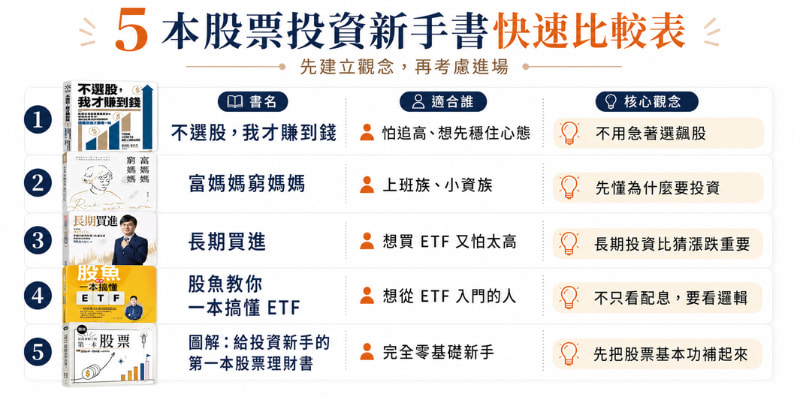
Quick Comparison Table of 5 Beginner's Guides to Stock Investing
| order | Book title | Who is it suitable for? | Established concepts |
|---|---|---|---|
| 1 | I only make money by not picking stocks. | People who are eager to jump into the stock market lately and are afraid of missing out on opportunities | Don't treat the stock market like a casino, and don't assume you can predict the market. |
| 2 | Rich Mom Poor Mom | Office workers, middle-class individuals, and those who want to move from salary to asset accumulation | Investing isn't about showing off skills; it's about making your money work for you. |
| 3 | Long-term buying | I want to buy ETFs, but I'm worried that prices are too high right now. | The hardest thing about investing is self-control, not guessing whether the market will go up or down every day. |
| 4 | "GuYu Teaches You to Understand ETFs" | People who want to buy 0050 or high-dividend ETFs but don't know what's wrong with them. | ETFs are not something you can buy blindly; you need to understand their types, strategies, and risks first. |
| 5 | Illustrated Guide: The First Book on Stock Investment for Beginners | People with absolutely no prior knowledge, who are even unfamiliar with opening an account or buying stocks. | First, brush up on your basic stock market knowledge and understand how the market works. |
(The mobile version of the table can be swiped left and right)
1. "I Only Make Money by Not Picking Stocks": The hotter the Taiwan stock market is, the more you should suppress the urge to pick stocks.
.png)
Product Link: Go Now
If you're considering buying stocks because of the recent surge in the Taiwan stock market, I'd recommend starting with "I Made Money Without Picking Stocks." This book is perfect as a first choice because it addresses a common mistake beginners make: immediately trying to pick a stock that's poised for a big rise.
Many beginners who are just starting to learn about investing don't think about "how to establish a long-term investment strategy," but rather about "which stocks are good to buy now?" "which stocks are going to crash?" "are there any next TSMC or Nvidia concept stocks?" The problem is, this kind of thinking is exciting, but it is also very dangerous.
Nicola Behube, the author of "I Made Money Without Picking Stocks," is a financial journalist. Instead of lecturing readers from a superior position, he discusses his own investment mistakes. The Lianjing Publishing page also mentions that the book immediately topped the Canadian bestseller list upon publication and has already sold rights to multiple countries. Its main theme is to discuss investing in a simple and stable way, rather than chasing stock market myths.
The most valuable aspect of this book for beginners is that it helps you understand that investing doesn't necessarily require stock picking. We often assume that successful investors are those who can precisely pinpoint lows and highs, and predict which stocks will rise. However, for most ordinary people, the more feasible approach is to reduce predictions, minimize impulsive actions, and simply engage with the market continuously.
Many online reviews also mention the book's warning against treating the stock market like a casino. One review from Green Corner Financial Notes points out that relying on intuition to predict market movements easily becomes unfounded speculation; if you approach the stock market with a betting mentality, it can ultimately lead to a casino-like outcome—a crucial point for beginners. Many newcomers to the stock market aren't genuinely interested in investing, but rather eager to prove their "foresight." However, investing isn't about proving your intelligence; it's more like a long-term practice of dealing with your own impulses.
The reason I recommend this book to beginners:
It's not telling you not to buy stocks, but rather reminding you not to think of investing as "winning only means picking a soaring stock." If you're really thinking of getting into the market recently, this book can help you put the brakes on your decision.
2. *Rich Mom Poor Mom*: Suitable for working professionals who are new to investing; first, understand why you should invest.
.png)
Product Link: Go Now
The second book I'd recommend is *Rich Mom, Poor Mom*. It's perfect for office workers and those with a modest income, especially those starting to feel that "a salary alone isn't enough." Many beginners want to start investing not necessarily because of greed, but because of anxiety. Rising prices, distant housing costs, limited salary growth, and more and more people around you buying stocks and ETFs—it makes you wonder, "Should I learn about investing too?"
The advantage of "Rich Mom Poor Mom" is that it doesn't throw a bunch of technical terms, financial statements, and industry analysis at you right away. Instead, it starts from a more down-to-earth perspective, talking about salaries, dividends, assets, cash flow, and how a person can gradually transition from earning money solely through labor to making money work for them.
According to Books.com.tw, this book was written by Chen Chung-ming and published on August 21, 2025. Its subtitle is "For those who don't want to be poor and busy their whole lives: 10 concepts to go from earning a salary to receiving millions in dividends." I think placing this book as the second in the book list is quite fitting because it helps beginners answer a more fundamental question: "Why do I want to invest?"
If someone hasn't figured out why they want to invest, and is just rushing in because the Taiwan stock market is rising, their friends are making money, or it's trending on social media, they're likely to end up buying at the peak, making haphazard purchases, getting trapped, and questioning their life choices. But if you first understand that the purpose of investing is to give yourself more options and more security in the future, rather than to show off your short-term skills, you'll be more level-headed when making a purchase.
Online reviews also mentioned that the book aims to convey the message that "money should be earned through investment, not just through hard work," and outlines concepts such as income management, long-term attitude, risk management, asset allocation, and emergency preparedness. These may sound basic, but for beginners, the basics are the most important. Many beginners are too quick to ask, "Which stock should I buy?", but they should actually ask themselves: "Do I have an emergency fund?", "How long can I hold this money?", "How much of a drop can I tolerate?", and "Am I aiming for short-term profit or long-term asset accumulation?"
The reason I recommend this book to beginners:
It doesn't just teach you about stocks; it first explains "why you invest." For those just starting out, this financial mindset is more important than learning technical analysis from the outset.
3. "Long-Term Buying": What beginners need most is not perfect accuracy, but self-discipline.
.png)
Product Link: Go Now
The third book is "Long-Term Buying," which I would recommend to those who have already started thinking about buying ETFs but are still hesitant. You might be thinking, "The Taiwan stock market is already so high, is it still a good time to buy?" or "If I invest regularly now, will I buy at the peak?" or you may have already bought ETFs but feel compelled to change your strategy every time you see the daily ups and downs.
This situation is perfect for reading "Long-Term Buying," a book by finance professor Zhou Guannan, with the subtitle "42 Lessons in Self-Discipline for Investing." The publisher's introduction also clearly states that this book is not for those who want to get rich quickly in the financial markets, but rather analyzes common investment products from a behavioral perspective and finally proposes long-term investment strategies. I think the word "self-discipline" is especially important for beginners.
Beginners often think the hardest part of investing is finding good targets, but they only realize the real challenge is:
When prices are rising, resist the urge to chase them too quickly.
When prices are falling, resist the urge to sell indiscriminately.
When others are making a lot of money, resist the urge to doubt your own methods.
When the market is hot, resist the urge to throw all your money into it at once.
That's the value of this book. It doesn't constantly tell you to rush in, but rather to let you know that investment performance is often defeated not by the market, but by your own behavior.
Reader reviews on Books.com.tw also mention that the book is easy to read and that the power of compound interest over time is significant for young investors. Other reviews highlight behavioral biases such as the gambler's fallacy, mental accounting, and anchoring effect – psychological traps that beginners often fall into. This is why I placed it as the third book in the series. After reading the first two books, you may already know not to pick stocks randomly and that investing is for long-term asset accumulation. Next, you need a book to help you build the ability to "execute over the long term."
The reason I recommend this book to beginners:
It will help you understand that investing isn't about guessing tomorrow's market movements every day, but about developing a method you can execute long-term. For beginners, this is more important than short-term trading techniques.4. "Stock Fish Teaches You to Understand ETFs": Don't buy just because you hear about high dividends or monthly payouts.
.png)
Product Link: Go Now
The fourth book is "Stock Fish Teaches You to Understand ETFs in One Book." Many novice investors are now entering the stock market for the first time not by buying individual stocks, but by starting with ETFs. Especially in Taiwan in recent years, high-dividend ETFs, monthly dividend ETFs, and thematic ETFs have been very popular. Many people feel that ETFs are simpler, more stable, and less likely to lose money.
But I must first say this: while ETFs are easier to learn than individual stocks, it doesn't mean you can skip research. Many beginners buy ETFs almost like they're following a well-known expert's advice. They see everyone saying 0050 is stable, so they buy 0050; they see high dividend yields, so they buy high dividend yields; they see monthly dividends are attractive, so they want to buy monthly dividend yields, without necessarily knowing whether they're buying a market capitalization ETF, a high dividend yield ETF, a bond ETF, or an industry-themed ETF. "Stock Fish Teaches You to Understand ETFs" fits this description perfectly because it's an introductory book written specifically for ETF beginners.
The Eslite Bookstore page mentions that this book will share ETF investment strategies and insights, making it suitable not only as a learning tool for beginners but also answering practical questions from those who have only a superficial understanding of investing. The content includes ETF types, ETF strategies suitable for different life stages, and common questions for beginners, such as whether to buy Taiwan stocks when they are already high, whether to continue investing in ETFs whose net asset value keeps rising, and how to choose between dividend-paying and non-dividend-paying ETFs. These are all questions that beginners frequently ask, especially regarding "high dividends," which is something beginners often misunderstand.
Many people believe that the higher the dividend payout, the better, but dividends don't just appear out of thin air. When it comes to ETFs, you need to consider the constituent stocks, the index logic, the source of the dividends, total return, and volatility risk. If you only look at the yield or listen to others saying "this one is very stable," you're likely to buy a product you don't actually understand. Some readers online have also shared that while this book contains a lot of information, it explains things in a relatively simple, conversational way, making it easier for beginners to read.
The reason I recommend this book to beginners:
Many beginners start by buying ETFs, so this article can help you fill in the gaps in your understanding of ETFs' basic logic. You don't need to understand all financial products from the beginning, but you should at least know what the ETFs you buy are actually investing in.
5. *Illustrated Guide to Stock Investment: The First Book for Beginner Investors*: Those with absolutely no prior knowledge can start with this book.
.png)
Product Link: Go Now
The fifth book is "Illustrated: The First Book on Stock Investment for Beginners," which I would categorize as a "basic stock market tool." If you are a complete beginner, and don't even understand how to open a securities account, how to buy and sell stocks, what a transaction price is, what dividends are, or what fundamentals are, then this book is perfect for you. Unlike the previous books, it doesn't focus as much on investment mindset or long-term strategies; instead, it's more like helping you build a solid foundation.
The Eslite Bookstore page describes the book as starting with the basics of opening a stock account, using diagrams to explain the practicalities of stock market operations, and reminding investors not to be misled by false information or insider tips. Linking Bookstore's information also shows that the book was published on August 24, 2023, authored by Hsieh Chien-ping and Lin Chieh-chen, and belongs to an illustrated series.
Why did I put it fifth? Not because it's unimportant, but because it's more like a foundational book that's easy to refer back to later. Some beginners are initially resistant to reading the basics, finding account opening, trading procedures, and stock terminology boring, and wanting to skip directly to which stocks to buy. But if you don't understand these fundamentals, no matter how many investment concepts you learn later, it will be difficult to truly apply them.
For example:
If you don't know the similarities and differences between ETFs and stocks in terms of trading methods, you might buy them randomly.
If you don't know what ex-dividend, ex-dividend, and yield are, you might only look at the dividend payout ratio.
If you don't understand that stock price fluctuations don't necessarily reflect the quality of a company, you might be frightened by daily market volatility.
Therefore, this book is very suitable for complete beginners to use to establish the basic language of the stock market.
The reason I recommend this book to beginners:
It's not the most glamorous investment book, but it's great for building a solid foundation. For complete beginners, understanding the basic terminology and trading logic first will prevent confusion when learning about ETFs, stock accumulation, and long-term investing.
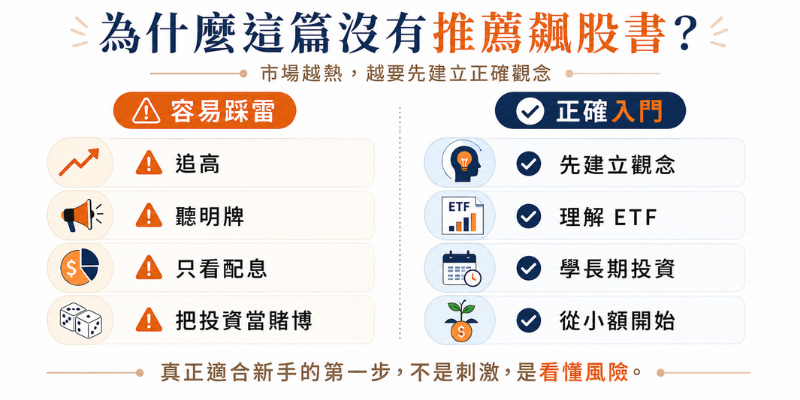
Why didn't this article recommend "The Book of Soaring Stocks"?
This book list deliberately avoids books that tout "quick returns," "catching soaring stocks," or "short-term riches." It's not that those books are completely unreadable, but for beginners, early exposure to such content can easily lead them to misunderstand investing as a thrilling game. Especially with the recent surge in the Taiwan stock market and the increasingly heated market atmosphere, it's easy to feel like you're falling behind if you don't get involved. If, at this point, you're looking at a lot of content about soaring stocks, day trading, and quick profits, beginners might mistakenly believe that the most important thing in investing is courage, rather than risk management.
But the first batch of investment books truly suitable for beginners should first help you establish a few concepts:
- Don't chase high prices just because you're afraid of missing out.
- Don't copy others just because they're making money.
- Don't buy ETFs based solely on dividend payouts.
- Don't mistake short-term fluctuations for your investment ability.
- Don't put too much money into the market before you understand the risks.
That's why I recommend these 5 books. They're not meant to turn you into an investment expert immediately after reading them, but rather to give you a better understanding of what you're doing before placing your first order.
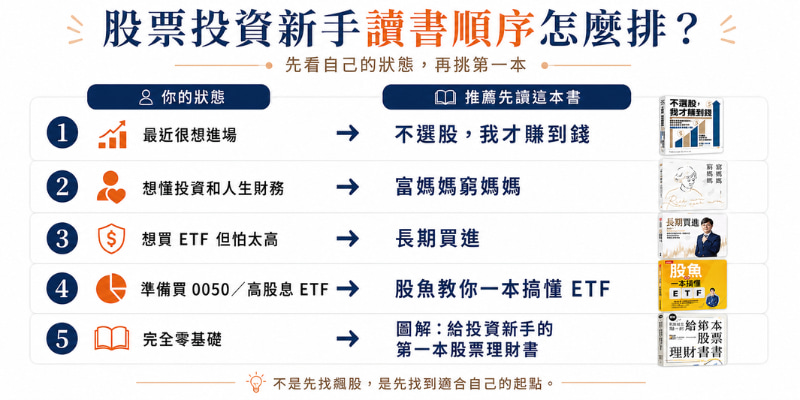
What is the recommended reading order for stock investment beginners?
If you're unsure which of these five books to start with, I would suggest reading them like this:
| Your status | I suggest you read this first. |
|---|---|
| I'm really tempted to jump in lately, but I'm afraid of missing out on the Taiwan stock market rally. | I only make money by not picking stocks. |
| You're an office worker and want to know how investing relates to your personal finances. | Rich Mom Poor Mom |
| You want to buy ETFs, but you're afraid the prices are too high right now. | Long-term buying |
| You already want to buy 0050, high-dividend ETFs, or monthly dividend ETFs. | "Stock Fish Teaches You to Understand ETFs" |
| You have absolutely no background knowledge; you don't even know how to buy stocks. | Illustrated Guide: The First Book on Stock Investment for Beginners |
(The mobile version of the table can be swiped left and right)
If you have absolutely no background knowledge, you can start with "Illustrated: The First Book on Stock Investment for Beginners" before going back to the previous books. However, if you already understand some stock market terminology and are just itching to invest because of the surge in the Taiwan stock market, I would recommend starting with "I Make Money Without Stock Picking" and "Long-Term Buying." Because what you need most right now is not trading skills, but rather to stabilize your investment mindset.
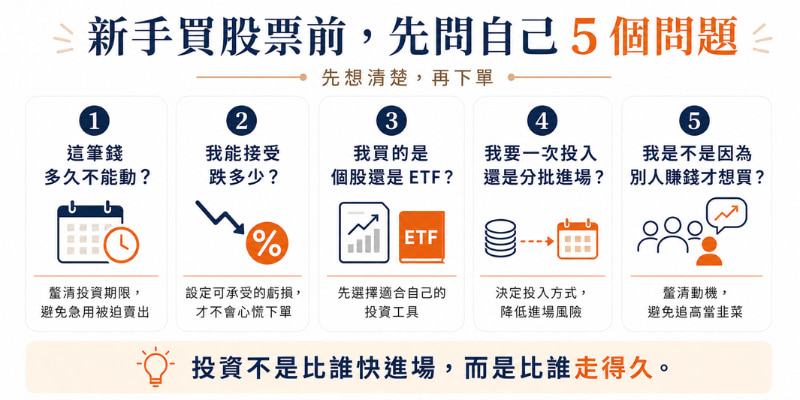
Before buying stocks, ask yourself these 5 questions.
Reading is the first step, but after finishing the book, don't rush to throw all your money into the market. Before actually placing an order, I would suggest you ask yourself five questions:
First, how long can this money remain untouched?
If you might need this money in three months, it's really not suitable to invest in stocks.
Second, how much paper loss can I accept?
Don't just think about how much you can earn; also think about how much the market can drop so you can still sleep soundly.
Third, should I buy individual stocks or ETFs?
Individual stocks require company research, and ETFs also require understanding the index logic; just because a stock sounds stable doesn't mean it's risk-free.
Fourth, should I invest all at once, or enter the market in batches?
The hotter the Taiwan stock market is, the less advisable it is for beginners to impulsively invest all their funds.
Fifth, am I only buying because others are making money?
If the answer is yes, then what you need most right now is not to place an order, but to do your homework first.
FAQ: Frequently Asked Questions for Stock Investment Beginners
Q1: Do stock investment novices need to read books first?
Not necessarily, but highly recommended. The biggest risk for beginners isn't a lack of capital, but rather not knowing what they're doing. Reading a few introductory books can at least help you avoid common mistakes like chasing high prices, relying on insider tips, buying high-dividend stocks indiscriminately, and overtrading.
Q2: I know absolutely nothing about stocks, can I buy an ETF first?
Yes, you can, but don't skip any research just because ETFs seem simple. There are different types of ETFs, such as market capitalization ETFs, high-dividend ETFs, bond ETFs, and sector ETFs, each with different risks and suitable investors. If you're a beginner and want to start with ETFs, it's recommended that you at least understand the ETF's tracking index, constituent stocks, dividend distribution logic, and volatility risk.
Q3: The Taiwan stock market has already risen a lot. Is it still a good time to enter the market now?
There's no standard answer to this question because everyone's funds, time, and risk tolerance are different. For beginners, more important than "Is it okay to buy now?" is having your own investment strategy? Are you investing short-term or long-term funds? Can you accept a price drop after you buy? If you haven't thought these questions through, it's not advisable to rush into the market just because it's hot.
Q4: Are technical analysis books suitable for beginners?
You can look at technical analysis, but it's not recommended to focus on it from the start. Many beginners, when first learning candlestick charts, moving averages, and patterns, easily mistakenly believe they can predict short-term price movements based on charts. Rather than rushing to learn entry and exit techniques, it's better to first establish a risk awareness, a long-term investment mindset, and a basic understanding of commodities.
Q5: Can I start investing after reading these 5 books?
Reading the book doesn't guarantee you can immediately make a large bet, but it will give you a clearer understanding of what you're doing compared to someone who enters the market without any knowledge. Beginners are advised to start with small, phased investments based on their risk tolerance, rather than putting all their money into the market at once. Investing isn't about who enters first, but about who can survive and thrive the longest.
Conclusion: A truly good introduction to investing doesn't require you to place an order immediately, but rather to slow down.
The Taiwanese stock market has been rising recently, and many beginners are starting to consider investing, which is normal. When the market is hot, it's easy to get the illusion that if you're even a step behind, you'll miss out on a lifetime of opportunities. But I sincerely advise that it's precisely in these situations that you need to slow down. What beginners should really fear isn't missing out on a particular stock, but rather being driven by market sentiment before you've even established basic concepts. You think you're investing, but you're just buying because everyone else is buying.
This list of 5 recommended books for stock investing beginners isn't meant to turn you into a stock market guru, nor is it a call to jump into the market immediately. They're more like foundations: understand risk, understand ETFs, understand long-term investing, and understand why you want to invest. If you've recently developed a genuine interest in stocks, that's a good thing, but please don't rush to hand over your money to the market. First, finish reading a few books you truly understand, develop your own judgment, and then start investing. The stock market always offers opportunities, but if you damage your capital, confidence, and mindset from the start, they're the hardest to recover.
(This article is the property of Dauriac and may not be reproduced with images or text.)

You may be interested

Recommended topics
Top Charts
All articles
article keywords
Subscribe to newsletter
article outline