- front page
- Recommended Article
- Life
- How to choose an interior design company? 10 essential tips for beginners to avoid decorating pitfalls.
How to choose an interior design company? 10 essential tips for beginners to avoid decorating pitfalls.

Many people, like me, initially thought that finding an interior design company meant looking at their portfolio, style, and quotes, and then scheduling a consultation if they liked it. However, after reading many homeowners' experiences shared on Dcard, PTT, and Mobile01, I found that the points of contention often weren't "the design wasn't pretty enough," but rather unclear quotes, constant additional charges during construction, communication breakdowns, project delays, unclear contracts, and even discovering during the final inspection that the finished product differed greatly from their expectations. These problems are very common in decorating experience sharing, especially the lack of detailed items in the quote, vague material specifications, and additional costs during construction—these are the areas most easily overlooked by beginners.
In conclusion: When choosing an interior design company, don't just look at their portfolio photos.
Many interior design companies have beautiful portfolio photos, showcasing excellent lighting, photography, and furnishings. However, what truly impacts your decorating experience is often what the photos don't show. For example, is the company legally registered? Is their quote detailed enough? Do they proactively remind you about budget allocation? Is there a designated window for the construction process? Do additional items require written confirmation? These are the key factors that ensure a smooth and worry-free decorating process.
The Ministry of the Interior's interior decoration contract template clearly lists the scope of work, drawings, estimates, construction period, and total project price as key contract points. This means that decoration is not something that can be agreed upon verbally; the clearer the documents, the fewer disputes there will be later.
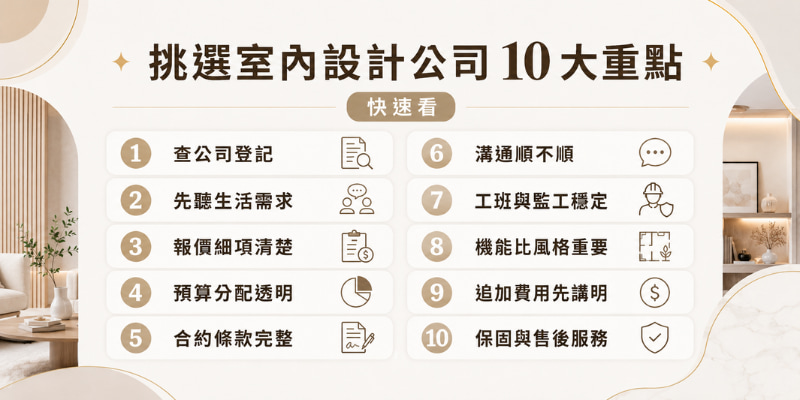
10 Key Considerations for Choosing an Interior Design Firm
| Select the key points | What do you want to observe? | Why it is important |
|---|---|---|
| 1. Is it legally registered? | Do you have company documents, interior decoration registration, or other relevant licenses? | Avoid dealing with unreliable individual contractors or construction workers who may be unsafe. |
| 2. Are you willing to listen to their needs? | Will they ask about lifestyle habits, budget, and family members first? | Comfortable living is more important than aesthetically pleasing |
| 3. Is the quote clear? | Do you list the item, unit, quantity, brand, and specifications? | To avoid continuous additions |
| 4. Does it explain the budget allocation? | Should design fees, engineering fees, supervision fees, and furniture and appliance fees be discussed separately? | Only then did I realize where the money went. |
| 5. Is the contract complete? | Are the construction period, payment, additional orders, acceptance, and warranty clearly defined? | Only then will there be a basis for action when problems arise. |
| 6. Is communication smooth? | Are you patient when asking questions? Are your answers clear? | Communication costs are very high during the renovation period. |
| 7. Is the work shift stable? | Are there long-term working groups? Who is responsible for on-site management? | Affecting construction quality and progress |
| 8. Is functionality important? | Have storage, traffic flow, plumbing and electrical systems, ventilation, and waterproofing been discussed? | You only realize the difference after living there for a while |
| 9. Are you willing to discuss risks? | Will they first discuss the limitations, potential additions, and construction difficulties? | Be careful if you only report good news and not bad news. |
| 10. Is there an after-sales warranty? | Who handles problems after completion, how long is the warranty, and how to report repairs? | To avoid not being able to find anyone after completion |
(The mobile version of the table can be swiped left and right)
1. First, check if the interior design company is legally registered.
Many beginners looking for interior design companies start by looking at their portfolios on Instagram, but I would suggest first confirming whether the company is actually listed on your website. Interior design isn't like buying a sofa you can return if you don't like it. It involves plumbing, electrical work, carpentry, masonry, waterproofing, fire safety, and wiring, and the costs often range from hundreds of thousands to millions of dollars. If you don't even know the company's information, registration details, and contact person from the beginning, you'll face significant problems later.
When netizens discussed choosing an interior designer on Mobile01, some mentioned that company registration and design and engineering management licenses are one of the basic criteria. Although registration does not guarantee that you will not encounter any problems, it at least means that the other party is not a completely untraceable entity.
The Ministry of the Interior's "Regulations on the Management of Interior Decoration of Buildings" also regulates the qualifications of professional and technical personnel in interior decoration, including qualifications such as architects, civil or structural engineering technicians, and building interior decoration project management.
If you're a beginner looking for an interior design company, here are three things you should ask them first.
What is the company's full name?
Do you have any registration or relevant licenses for interior decoration businesses?
Is the contract with a company or an individual?
2. A good design company will first ask about your lifestyle, not just what style you like.
During your first consultation, observe the questions the designer asks. If they only ask, "Do you prefer modern, cream, or wabi-sabi style?" it's not necessarily bad, but it's not enough. A home isn't just for taking pictures. Once you actually live there, you'll care about things like storage, electrical outlets, kitchen cleanability, wardrobe dampness, bathroom slipperiness, and whether your family's schedules will disturb each other.
On PTT (a popular Taiwanese online forum), there are also tips on avoiding common renovation pitfalls. During the first meeting, observe whether the designer first inquires about the residents' schedules, health conditions, and budget priorities, rather than just showing photos of their portfolio or trendy styles. You can ask the designer, "If I have a limited budget, where would you suggest I prioritize my spending?" This question is very useful. A truly experienced designer will help you prioritize: what's essential for safety, plumbing, waterproofing, and basic construction, and what can be added later, like furniture or soft furnishings. If the designer only pushes up the price of materials without prioritizing needs, be wary.
3. Always read the detailed items in the quotation, don't just look at the total price.
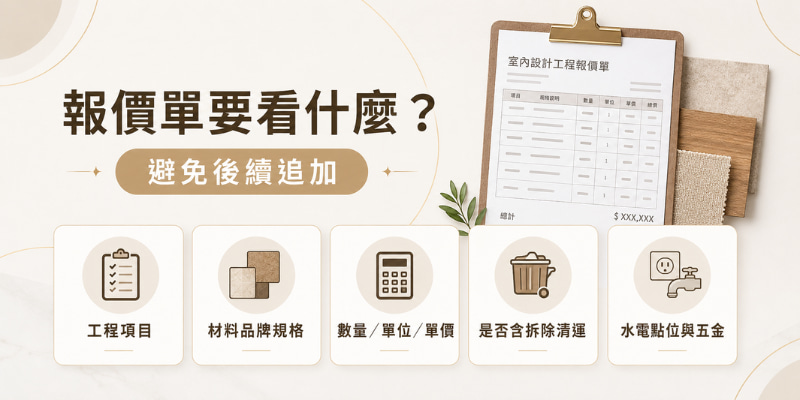
This is where most people make mistakes. Many beginners, upon receiving a quote, only look at the final total price and assume that Company A's quote of 1.8 million and Company B's 1.5 million mean Company B is cheaper. However, the problem is that the two quotes may contain completely different details. Dcard's beginner decorating guide mentions that if a quote only lists "Total Price for Interior Decoration," "Total Price for Plumbing and Electrical Work," and "Total Price for Carpentry Work," but lacks details such as units, quantities, materials, labor, cleaning, and demolition, additional costs can easily arise later.
A reasonably valuable quotation should include: the project scope, work area, quantity, unit, unit price, material brand, model and specifications, whether demolition, removal, protective works, water and electricity points, painting, and hardware accessories are included. Pay special attention to phrases like "one-style" or "single-style." While "one-style" isn't entirely forbidden, if it appears repeatedly without explanation, it becomes difficult to understand what you've actually purchased.
4. Don't be misled by the lowest price; unusually cheap prices usually have a reason.
Home renovation is expensive, and wanting to save money is normal. However, when choosing an interior design company, the biggest fear isn't high prices, but rather that it "looks cheap at first, but keeps adding extra charges later." Many renovation disputes online are related to additional fees. A common scenario is that the initial quote is very attractive, but after construction begins, it's revealed that certain items weren't included, or that materials, installation, demolition, moving, waste removal, and community fees are calculated separately. Articles related to renovation disputes also remind everyone that additional items should be discussed and agreed upon by both parties, and the quote shouldn't just focus on the total price; it's also important to confirm the details and material brands clearly.
My advice is to compare at least three options, but don't just compare the total price. The one that's truly worth choosing isn't necessarily the cheapest, but rather the one that lets you know exactly where your money is going.
You can look at the three quotes together:
Which company's project description is the clearest?
Which company proactively reminds you of the possibility of additional charges?
Which company provides information on material grades?
Which company dares to clearly state the payment terms, construction period, and warranty?
5. Don't rush to sign the contract; pay special attention to the payment terms, additional charges, construction period, and acceptance procedures.
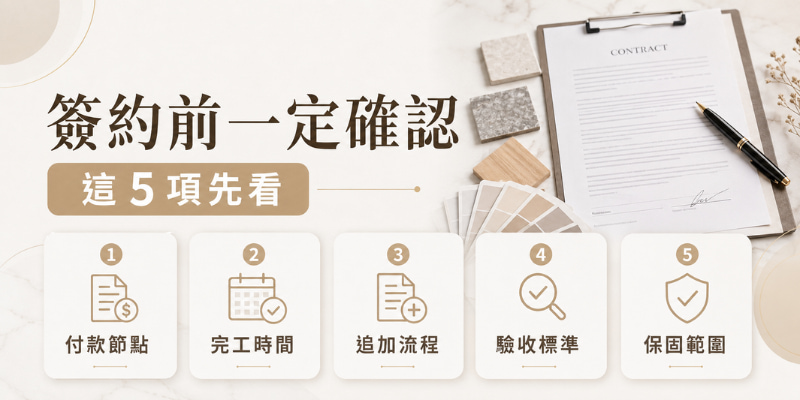
Many people are excited when decorating; once the drawings are confirmed, the style is liked, and the budget seems manageable, they quickly sign a contract. However, the contract is your last line of defense. The Ministry of the Interior's standard contract for interior decoration work specifies a minimum 7-day review period and lists the scope of work, construction period, total price, and attached cost estimates. These are not just formalities, but crucial evidence in case of future disputes.
Key points to confirm in the contract: Don't pay too much at once; ideally, link the payment to the project schedule. Any additional items must be confirmed in writing, not just mentioned via LINE. The construction period must clearly state the start and end dates. The acceptance method must be clearly stated, specifying what constitutes a defect and the timeframe for rectification. The warranty coverage must also be clearly stated, detailing how plumbing, waterproofing, carpentry, and hardware are calculated. The biggest problem in renovations is when something is agreed upon but not written down. Verbal promises are rarely sufficient protection when problems arise.
6. In addition to looking at the photos of the completed work, you should also pay attention to the "construction details" and "finishing touches".
Portfolio photos are important, but don't just focus on whether the living room is beautiful or the lighting is pretty. The true skill of a design firm often lies in the details. For example, cabinet trim, door gaps, tile alignment, socket placement, air conditioning drainage, bathroom waterproofing, internal cabinet storage, and cleaning/maintenance access points – these are the issues you'll encounter daily after moving in.
When sharing their decorating experiences, some netizens also specifically remind others to compare quotes and drawings, because it's best to understand each item with accompanying drawings; otherwise, it's easy to have a misconception.
When reviewing case studies, you can ask these questions:
What problems did the homeowner originally encounter in this case?
What functional adjustments did you make?
Were there any construction restrictions encountered on site?
Were there any additional payments later? Why?
It's usually more valuable to learn from designers who can explain their process rather than just saying "this style is popular".
7. Good communication is very important, because decorating isn't something that can be finished in one conversation.
Finding an interior design company isn't like buying a ready-made product; it's a collaboration that can last several months, from measurement, proposals, quotations, signing contracts, material selection, construction, supervision, and acceptance, to post-completion repairs—all involving a great deal of communication. If the company is slow to respond, speaks vaguely, or avoids the important issues from the start, it will usually only make things more painful later on.
In a discussion on Dcard among first-time home decorators, it was mentioned that many people's biggest initial struggles are not understanding quotes, having saved numerous images on Pinterest but unable to articulate their needs, and not knowing how to manage their budget. At this point, the ability of a design company to clearly explain complex issues becomes crucial.
Good communication doesn't mean always going along with your wishes.
A good designer won't necessarily say yes to everything. They might tell you, "This budget is not feasible," "This material is difficult to maintain," "This configuration will not work in the future," or "This traffic flow will be obstructed." These kinds of statements may not sound very appealing, but they are actually more trustworthy than those who agree to everything from the beginning and then say no during construction.
8. Make sure to find out who is in charge of supervising the construction; don't assume the designer is on-site every day.
Many beginners assume that if they hire an interior design company, the designer will be on-site every day. However, in reality, each company has a different division of labor. Some companies have designers who also manage, some have project managers, some have permanent construction staff, and some have outsourced construction teams that handle everything themselves.
Therefore, you must ask clearly before signing the contract:
Who is the main window?
Who is in charge of on-site supervision?
How often should I report my progress?
Will you provide construction photos?
If a problem arises on-site, who decides how to handle it?
Articles related to interior design also mention that construction management fees are usually used for supervision and site coordination, but different companies charge in different ways. Some will specify it in the contract, while others will include it in the overall quotation. Therefore, it is important to confirm this before signing the contract to avoid misunderstandings.
9. Make sure to confirm how additional fees are calculated.
It's not always realistic to avoid any additional costs during the renovation process. Once the renovation is complete, you might discover outdated plumbing, poor wall condition, the need to redo the waterproofing, or that the homeowner might change their needs midway through. The issue isn't "can we add anything?", but rather "how are these additions proposed, confirmed, and priced?" Articles on contracts and renovation disputes emphasize that any new items or changes should ideally be confirmed in writing by both parties, specifying the exact costs and scope of work to avoid future disputes.
Additional fees must include three things:
Add reason
Additional amount
Will it affect the construction period?
Don't accept a response that starts with just "This will cost extra." Additional charges are acceptable, but they must be transparent.
10. Post-completion warranty and repair are more important than you think.
Many people only think about the completion day when choosing an interior design company, but the real test is after moving in. Will the cabinet doors be crooked? Are the drawer slides smooth? Are there any cracks in the paint? Will the bathroom leak? Are there any abnormalities in the sockets? Will the air conditioner drain leak? Sometimes these problems are not visible immediately after completion, but are discovered after living there for a while.
After completion, be sure to ask:
How long is the warranty?
Which items come with a warranty?
Which types of damage are not covered under warranty due to human error?
What is the repair request process?
How long will it take to get a reply?
Finding someone to help you after it's finished is more important than having a pretty portfolio.
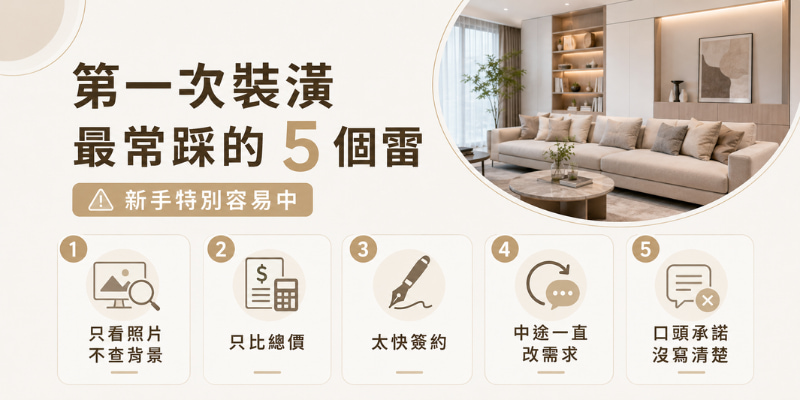
5 common mistakes beginners make
After compiling experiences from netizens, I think people hiring an interior design company for the first time are most likely to make these mistakes:
1. Only looked at the photos, without checking the company background.
Beautiful portfolio photos can be used as a reference, but they shouldn't be the sole basis for evaluation. You should check the company, its registration, and customer reviews, and also see if they are willing to provide a clear contract and price quote.
2. Only the total price was compared, not the contents.
1.5 million isn't necessarily cheaper than 1.8 million, because some things might not be included. What really matters is the project, materials, construction methods, management, and warranty.
3. Signed the contract too quickly without carefully reviewing it.
A contract is not just a formality. You need to review everything, including payment terms, additional fees, construction period, acceptance procedures, and warranty.
4. Requirements kept changing midway through.
Homeowners also need to take responsibility. Constantly changing requirements will definitely affect the construction period and budget. Thinking things through before signing the contract is much cheaper than making changes after construction begins.
5. Hoping the designer can communicate with the supernatural
You don't necessarily need to know about interior design, but you should try to clearly explain your living needs. Mention what you like, what you don't like, your budget limit, storage needs, and your family's habits.
Before hiring an interior design company, you can prepare these 6 documents.
Basic property information : size, age of the building, layout, whether it is a new or used property.
Budget scope : total budget, whether it includes furniture and appliances, and whether it includes air conditioning.
Residents : How many people live here? Are there children, elderly relatives, or pets?
Lifestyle habits : Do you cook often? Do you work from home? How much storage do you have?
Preferred style : You can prepare pictures, but don't just give a single style name.
Things I can't accept : I don't like open kitchens, I don't want too much woodwork, and I don't want kitchens that are difficult to clean.

FAQ: Common Questions When Choosing an Interior Design Firm for the First Time
Q1: Are interior design companies always more expensive than turnkey projects?
Not necessarily. Interior design companies typically offer services including design planning, drawings, material selection, and project management, while turnkey projects focus more on overall project integration. The difference isn't just about price, but rather whether you require complete design and management. If you have absolutely no decorating experience, it's more important to find someone who can clearly explain the process.
Q2: Is it better to have a more detailed quote for interior design?
In principle, yes. The more detailed the quote, the clearer you'll know where the money is going, and the less likely you are to encounter disputes later. However, be aware that some very preliminary estimates won't be extremely detailed; always request a complete quote that corresponds to the drawings before signing the contract.
Q3: Before looking for an interior design company, do I need to know what style I like?
You don't need to know everything, but you can start by organizing the pictures you like and dislike. Rather than simply saying "I like creamy style," a better approach is to explain whether you like the colors, textures, lighting, or the overall atmosphere.
Q4: Is it reasonable for interior design companies to charge for proposals?
Reasonable. A good proposal requires measurement, communication, preliminary planning, and time. But you should first confirm what the proposal fee includes, such as the floor plan, style proposal, initial quote, and whether it can be deducted from the final contract.
Q5: How can I tell if an interior design company will add unnecessary charges?
There's no way to guarantee 100% accuracy, but you can look at three things: whether the quote is detailed, whether the contract outlines any additional procedures, and whether the other party is willing to explain any potential additional risks before construction begins. The worst scenario is when they say everything is fine before signing the contract, but then demand extra money for every single item during construction.
Conclusion: A good interior design company doesn't just make a house look beautiful.
When hiring an interior design company for the first time, there's no need to rush into a decision. Interior design isn't simply a matter of aesthetics; it's a comprehensive assessment of budget, lifestyle, construction, communication, and trust. Beautiful photos may tempt you, but a clear quote, a complete contract, a stable construction team, and responsible communication will give you peace of mind.
I think the most important thing for beginners to remember is this: when choosing an interior design company, don't choose the one that's best at taking photos, but rather the one that can clearly explain the problems, clearly outline the risks, and clearly understand your lifestyle. If a company is willing to take the time to understand your life before signing a contract, and is willing to clearly explain the price, materials, construction period, additional charges, and warranty, then it at least shows that they are not just looking to close the deal, but genuinely planning this home as a space to be used long-term. A renovation might be something you live in for ten or twenty years. Finding the right person isn't just about saving money; it's about avoiding a lot of regrets.
(This article is the property of Dauriac and may not be reproduced with images or text.)

You may be interested

Recommended topics
Top Charts
All articles
article keywords
Subscribe to newsletter
article outline