- front page
- Investment and wealth management
- invest
- How to choose between 0050, 006208, 00878, 0056, and 00919? A comparison table of popular ETF recommendations, easy for beginners to understand at a glance.
How to choose between 0050, 006208, 00878, 0056, and 00919? A comparison table of popular ETF recommendations, easy for beginners to understand at a glance.
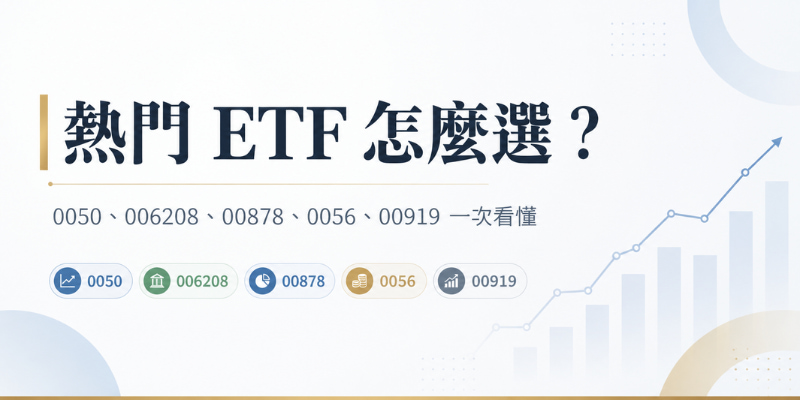
In recent years, Taiwanese people have really loved buying ETFs. In the past, when it came to investing, many people would first think of buying stocks, listening to insider tips, and looking for soaring stocks. But now it's different. More and more people are starting to use ETFs to save stocks, make regular fixed-amount investments, and even regard ETFs as part of their retirement savings, cash flow, and asset allocation.
According to data from the Taiwan Securities Investment Trust and Consulting Association, as of the end of January 2026, the total number of ETF beneficiaries in Taiwan was approximately 15.74 million, of which approximately 12.01 million were beneficiaries of Taiwan stock ETFs. This represents a significant increase compared to 460,000 beneficiaries at the end of 2019. This also indicates that ETFs are no longer just a tool for a select few investors, but rather an investment option that many small investors, beginners, and those looking to accumulate shares are exploring.
Before recommending ETFs, understand the difference between market capitalization ETFs and high-dividend ETFs.
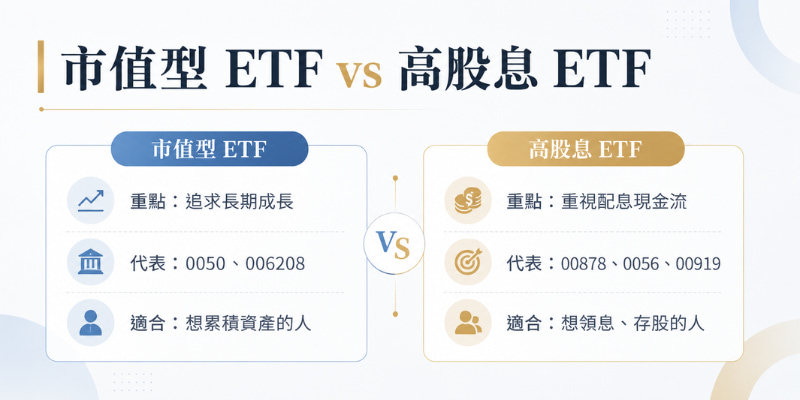
Many beginners confuse ETFs, thinking they're all similar since they're all ETFs, but they're actually quite different. 0050 and 006208 are more like "market capitalization ETFs," their core logic being to buy large-cap Taiwanese companies and grow alongside these large-cap stocks. 00878, 0056, and 00919, on the other hand, are more like "high-dividend ETFs," their core logic being to select stocks with dividend payout capabilities and whose dividend conditions comply with index rules, giving investors a clearer sense of dividends.
Comparison table of market capitalization ETFs and high dividend ETFs
| type | ETF | Core Logic | Suitable for needs |
|---|---|---|---|
| Market capitalization ETFs | 0050, 006208 | Growing alongside large Taiwanese enterprises | Long-term asset accumulation, regular fixed-amount investment, core asset allocation |
| High Dividend ETFs | 00878, 0056, 00919 | Select high-dividend stocks to create a sense of dividend payout. | People who want cash flow, stock investors, and those who value dividends |
(The mobile version of the table can be swiped left and right)
Neither is inherently better than the other; they simply serve different purposes. If you prioritize long-term asset growth and are willing to accept market fluctuations, market capitalization ETFs are more suitable for core holdings. If you expect quarterly or periodic dividend income and prefer to "see cash flow," high-dividend ETFs will provide a more tangible benefit. The real problem isn't buying the wrong ETF, but rather focusing solely on dividends when you prioritize growth, or buying a low-dividend ETF when you prioritize cash flow, only to then begin to doubt your investment decisions.
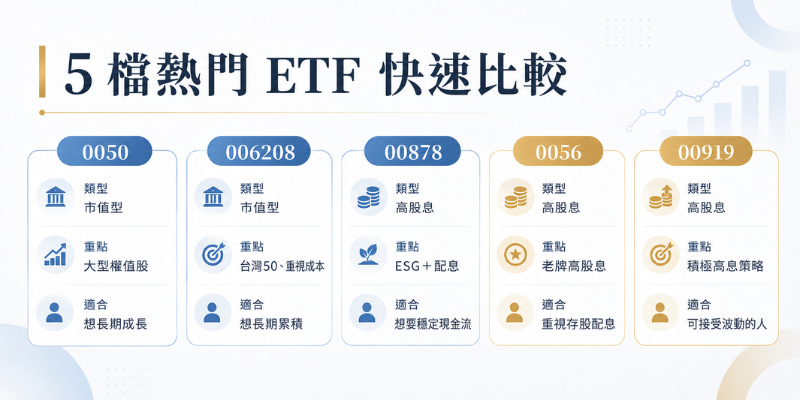
Comparison Table of Popular ETFs: 0050, 006208, 00878, 0056, 00919
| ETF | Tracking Index/Theme | Asset size and number of beneficiaries | Dividend Status | Suitable for ethnic groups |
|---|---|---|---|---|
| 0050 Yuanta Taiwan 50 (Market capitalization type) | FTSE Taiwan 50 Index, large-cap stocks | The total assets amounted to approximately RMB 1,891.407 billion, with approximately 2.9341 million beneficiaries. | There is a history of dividend payouts, but the focus is not on high dividends. | People who want to participate in the long-term growth of Taiwan's leading large enterprises |
| 006208 Fubon Taiwan 50 (Market capitalization type) | FTSE Taiwan 50 Index, large-cap stocks | The total assets are approximately RMB 426.23 billion, and the number of beneficiaries is approximately 686,600. | Profit distribution twice a year | For those who want to buy Taiwan 50 but are concerned about long-term costs and expense ratios |
| 00878 Cathay Life High Dividend (High dividend) | MSCI Taiwan ESG Sustainable High Dividend Select 30 Index | The total assets are approximately RMB 561.082 billion, with approximately 1.5922 million beneficiaries. | Quarterly dividend payout; recent dividend payout record includes NT$0.66 per unit on June 12, 2026. | For those seeking high dividends, ESG themes, and relatively stable cash flow |
| 0056 Yuanta High Dividend (High dividend) | Taiwan High Dividend Index | The total assets amount to approximately RMB 660.904 billion, with approximately 1.5469 million beneficiaries. | Quarterly dividend payout; recent dividend payout record includes NT$1.0 per unit on May 14, 2026. | People who want to buy established high-dividend ETFs and value market familiarity |
| 00919 Yuanta Taiwan Selected High Interest (High dividend) | Taiwan Index Company's Selected High-Yield Index for Listed and OTC Companies in Taiwan | The total assets amount to approximately RMB 490.228 billion, with approximately 1.2623 million beneficiaries. | Quarterly dividend payout; recent dividend payout record includes April 14, 2026: NT$0.78 per unit. | For those seeking a more aggressive, high-yield strategy and who can tolerate volatility. |
(The mobile version of the table can be swiped left and right)
The above information is compiled based on publicly available information from the Taiwan Stock Exchange's e-Tianfu platform and various investment trust companies. Figures such as asset size and number of beneficiaries may change with the market. For actual information, it is still recommended to refer to the official announcements of listed companies and investment trust companies.
*Both 0050 and 006208 track the FTSE Taiwan 50 Index; 0050 is currently the largest Taiwan stock ETF in terms of both the number of beneficiaries and asset size, while 006208 is often compared with 0050 in terms of expense ratio and long-term holding cost. ( Taiwan Stock Exchange data)
*00878, 0056, and 00919 are all high-dividend ETFs, but their stock selection logic differs. 00878 combines ESG considerations with high dividends, 0056 tracks the Taiwan High Dividend Index, and 00919 tracks the Taiwan Index Corporation's Selected High-Dividend Index for Listed and OTC Companies in Taiwan. (Data from the Taiwan Stock Exchange )
What is 0050? It's suitable for people who want to participate in the long-term growth of large Taiwanese companies.
0050 is the first ETF many people are familiar with. It tracks the FTSE Taiwan 50 Index, which, simply put, selects the 50 largest companies by market capitalization listed on the Taiwan Stock Exchange as its constituent stocks. Yuanta Securities Investment Trust also explains that the Taiwan 50 Index is jointly compiled by the Taiwan Stock Exchange and FTSE International Limited.
Therefore, buying the 0050 index is not about buying a single company, but rather a basket of large-cap, heavyweight Taiwanese stocks. The advantages of the 0050 index are its simplicity, intuitiveness, large scale, and high liquidity. For beginners, it doesn't require daily research into which companies will rise or guessing which industry will be the strongest tomorrow. You only need to understand one thing: if you believe that large Taiwanese companies will remain competitive in the long term, the 0050 index is an easy-to-understand tool.
However, the 0050 ETF isn't without its drawbacks. Its constituent stocks are influenced by market capitalization weighting, resulting in a typically higher proportion of large-cap stocks. When TSMC and other electronics heavyweights perform strongly, the 0050 may benefit; but if large-cap electronics stocks correct, the 0050 will also fluctuate. More importantly, the 0050 is not a high-dividend ETF. If you buy it solely for the prospect of receiving large quarterly dividends, your expectations may be significantly disappointed. The 0050 focuses more on "long-term growth" than "high dividends."
Who is 0050 suitable to buy?
0050 is suitable for people who want to invest in core assets of Taiwan stocks for the long term. If you are a beginner and do not want to study too many high dividend rules, stock switching logic and dividend yield traps at the beginning, then 0050 will be a very intuitive introductory option.
Suitable for : those who want to accumulate assets over the long term, those who want to invest regularly, and those who want to buy shares in large, leading Taiwanese companies.
Not necessarily suitable for : those who want to receive high dividends every quarter
I don't recommend buying with this mindset : wanting to quickly profit from price differences in the short term.
What is 006208? It's very similar to 0050, but it's often used to compare costs.
006208 also tracks the FTSE Taiwan 50 Index, and like 0050, it belongs to the market capitalization ETF category. According to data from the Taiwan Stock Exchange's e-Taiwan ETF platform, the underlying index of 006208 is also the FTSE Taiwan 50 Index, and its security category is Taiwan Stock ETF. Therefore, many people ask: "Since both 0050 and 006208 track the Taiwan 50, what are the differences?" The differences usually lie in several areas: size, liquidity, expense ratio, investment trust brand, and the investor's own trading habits.
A notable feature of ETF 006208 is its expense ratio, which is frequently discussed by investors. According to Fubon Securities Investment Trust, 006208's manager fees are tiered by fund size; the larger the fund, the more tiered the manager fees become. Official data also lists profit distributions as twice a year. For long-term investors, the expense ratio is indeed worth considering. This is because you're not just buying for a month, but potentially holding for 5, 10, or 20 years. Over the long term, deducted costs will gradually impact investment returns. However, the "expense ratio" shouldn't be the sole criterion. For ETFs, liquidity, premium/discount, trading volume, ease of holding, and your own understanding of the underlying asset are also crucial factors.
Who is 006208 suitable to buy?
006208 is suitable for those who already understand the logic of the Taiwan 50 Index and are willing to compare long-term costs. If you think 0050 and 006208 are similar, you can compare them from these perspectives:
Comparison table of 0050 and 006208
| Comparison angle | 0050 | 006208 |
|---|---|---|
| Tracking Index | Taiwan 50 | Taiwan 50 |
| Investment Logic | Large-cap stocks | Large-cap stocks |
| Market awareness | Very high | high |
| Asset size | Larger | Also of considerable scale |
| Suitable for use | Core configuration, regular quota | Core configuration and long-term cost comparison |
(The mobile version of the table can be swiped left and right)
What is 00878? It offers high dividends and ESG benefits, making it suitable for those seeking cash flow but avoiding excessive volatility.
00878 is a popular high-dividend ETF in recent years, officially named Cathay Sustainable High Dividend ETF. It tracks the MSCI Taiwan ESG Sustainable High Dividend Select 30 Index, with themes including corporate governance, ESG, and high dividends. According to data from the Taiwan Stock Exchange's e-Funded ETF, 00878 has assets under management of approximately NT$561.082 billion and approximately 1.5922 million beneficiaries.
00878's appeal lies not only in its "high dividend" but also in its inclusion of ESG sustainability concepts. It doesn't simply focus on high dividends; instead, it incorporates corporate governance, sustainability ratings, and dividend conditions into its stock selection logic. For many investors, 00878's attractiveness lies in its perceived dividend payout without the stimulating excitement of some high-yield strategies. Of course, this doesn't mean it's risk-free. ETF prices still fluctuate, and dividend payouts don't guarantee profits.
Many people make a mistake when buying high-dividend ETFs: they only look at the dividend payout. For example, if they see a large dividend payout in a certain quarter, they think the ETF is good; if they see a smaller payout in another quarter, they think it's bad. But in reality, what you should look at when buying high-dividend ETFs is not the dividend payout in a single quarter, but rather the long-term total return, net asset value changes, dividend-filling ability, and the quality of the constituent stocks.
Who is 00878 suitable to buy?
00878 is suitable for those who want quarterly dividends but also want a high-dividend strategy that doesn't solely revolve around the dividend yield.
It is suitable for these types of people:
Suitable for : those who want quarterly dividends, high dividends + ESG themes, and those who want more diversified portfolios than individual stocks.
Not necessarily suitable for : those who only seek the highest yield.
Not suitable for : Those who cannot accept net asset value fluctuations
00878 is more like a high-dividend ETF option that is "clear in its image, has a wide audience, and a clear sense of dividend payout". It may not be the one with the highest dividend payout, but for many stock investors, its advantage lies in its ease of understanding and the psychological stability of holding it for the long term.
What is 0056? It's a well-established high-dividend ETF, suitable for those who value market familiarity.
0056 is a high-dividend ETF that is very familiar to Taiwanese investors. According to Yuanta Securities Investment Trust, the Taiwan High Dividend Index tracked by 0056 is selected from the sample population composed of the Taiwan 50 Index and the Taiwan Mid-Cap 100 Index, and the constituent stocks with higher dividend yields are selected. The index selects the 50 stocks with the highest projected cash dividend yields for the next year, and the weights are determined by cash dividend yields, not market capitalization.
0056 doesn't buy the largest companies; instead, it selects stocks based on the logic of high dividends. This is why, although both 0056 and 0050 are popular, their investment concepts are completely different. 0050 is more like a "representative team of large Taiwanese companies," while 0056 is more like a "representative team of companies with expected high dividends."
The advantages of 0056 are its long history, high market familiarity, and high level of discussion. Many people immediately think of 0056 when discussing high-dividend ETFs. However, its risks must be carefully considered. Because it is a Smart Beta high-dividend index, Yuanta Securities Investment Trust has also revealed that such indices may underperform market capitalization-weighted indices in certain market conditions, and may have a significant proportion of their holdings invested in smaller-cap companies. Therefore, you cannot assume that just because it is an established ETF, it is necessarily stable and will not experience losses.
Who is 0056 suitable to buy?
0056 is suitable for those who want to buy high-dividend ETFs and value market familiarity. It is suitable for the following types of people:
Suitable for : those who want high-dividend ETFs, those who want to buy established popular stocks, and those who want the experience of quarterly dividends.
Not necessarily suitable for : those looking to buy large-cap growth stocks.
Not suitable for : those who want to completely avoid volatility
If you buy 0056, you need to understand its essence: it is not a large-cap ETF of Taiwan stocks, nor is it simply buying the largest company in Taiwan. Instead, it uses high dividends as a criterion to screen stocks. This strategy may be very popular at certain times, but it may also lag behind when growth stocks are strong.
What is 00919? It employs a more aggressive high-interest strategy, suitable for those who can tolerate volatility.
00919 is a high-dividend ETF that has been widely discussed in recent years. According to data from the Taiwan Stock Exchange's e-Taiwan Asset Management, 00919 tracks the Taiwan Index Corporation's Selected Taiwan Listed and OTC High-Dividend Index, with assets under management of approximately NT$490.228 billion and approximately 1.2623 million beneficiaries. Yuanta Securities Investment Trust explains that 00919's index selection focuses on high-dividend stocks and discloses that such Smart Beta indices do not guarantee outperformance of the market at all times; in situations of industry rotation, poor performance of constituent stocks, or the impact of dividend information, the index performance may lag behind market capitalization-weighted indices or other performance indicators.
This section is definitely worth reading for investors, because 00919's appeal is obvious: strong dividend payout potential, high topicality, and high investor discussion. However, because it focuses on selecting high-dividend ETFs, investors shouldn't just look at a single quarterly dividend. High-dividend ETFs sometimes create a misconception: the higher the dividend, the more profitable it seems. But investing shouldn't just focus on "how much dividend was paid," but also on "whether the net asset value has kept pace," "whether the stock price has corrected," and "whether the total return is reasonable." If you're simply getting your principal back in another form, then you're not truly making more money.
Who is 00919 suitable to buy?
00919 is suitable for those who want a more aggressive, high-yield strategy and can accept price volatility. It is suitable for the following types of people:
Suitable for : those who want a high return on investment, those who want to research high-yield strategies, and those who can tolerate volatility.
Not necessarily suitable : I just want to leave it there and not look at it at all.
Not recommended : Don't go all in just because the dividend yield is high.
The key point about 00919 isn't "it has a lot of dividends, so it must be the best," but rather that you should understand it's a high-dividend ETF with a stronger strategic focus. If you're willing to study its stock selection logic, dividend sources, share conversion rules, and net asset value performance, it can be part of a high-dividend portfolio; however, if you're only attracted by the high dividends and don't understand the risks, it's easy to miss out when the market fluctuates.
How to choose between 0050, 006208, 00878, 0056, and 00919? Choose based on your purpose, not popularity.
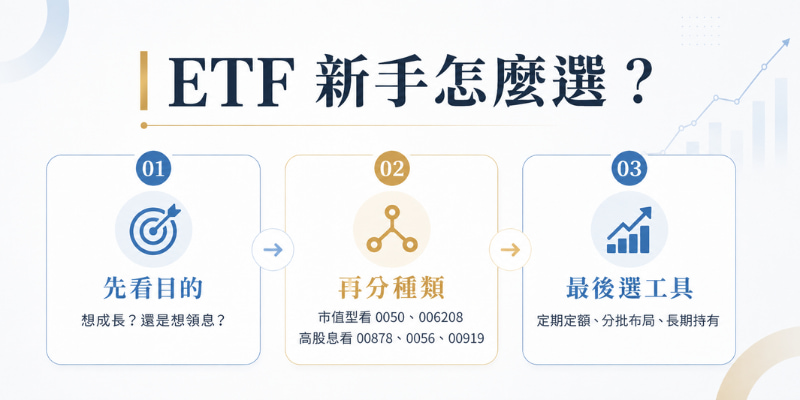
The biggest fear when choosing ETFs isn't buying an unpopular one, but rather not knowing what you're supposed to do with it. If you're a beginner, you can use this table to assess your options:
| Your investment needs | Priority research is possible |
|---|---|
| I want to accumulate assets over the long term and don't care much about dividends. | 0050, 006208 |
| I want to buy shares in a large, leading Taiwanese company, but I don't want to pick the stocks myself. | 0050, 006208 |
| I want to have a sense of cash flow every quarter. | 00878, 0056, 00919 |
| I want high dividends, but I hope the focus won't be solely on the dividend yield. | 00878 |
| I want to buy a well-established high-dividend ETF. | 0056 |
| I want to pursue a more aggressive high-interest strategy. | 00919 |
| I have absolutely no idea how to begin. | First understand 0050 and 006208, then compare high-dividend ETFs. |
| I cannot accept book losses. | Don't rush to buy; you should first learn about asset allocation and risk tolerance. |
(The mobile version of the table can be swiped left and right)
The simplest way to determine this is:
To grow : first look at 0050 and 006208
Looking for cash flow : consider 00878, 0056, and 00919.
This doesn't mean that market capitalization ETFs are always better than high-dividend ETFs, nor does it mean that high-dividend ETFs are always more suitable for retirees. A truly mature asset allocation strategy usually doesn't involve buying only one type of ETF, but rather determining the proportion based on your age, income, cash flow needs, and risk tolerance. For example, young professionals might prioritize asset growth and allocate a higher proportion to market capitalization ETFs; those nearing retirement or needing more cash flow might increase their allocation to high-dividend ETFs. This isn't a standard answer, but rather a reflection of different investment objectives.
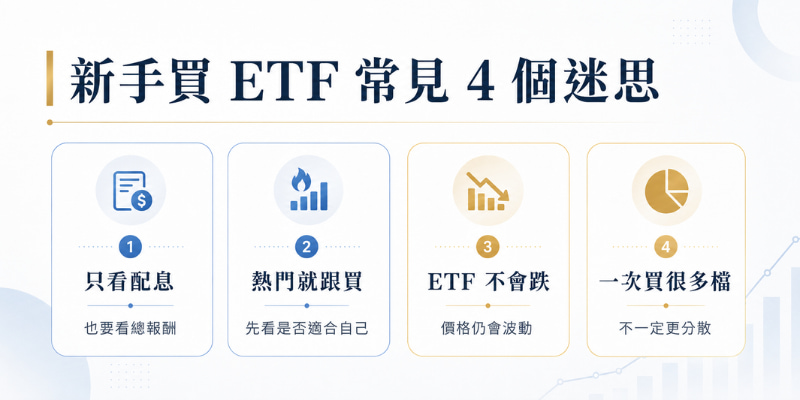
5 Common Mistakes Beginners Make When Buying ETFs
1. Only look at dividends, not total returns.
This is the most common misconception about high-dividend ETFs: high dividends do not necessarily mean high total returns. What you should look at is not "how much this quarter", but the overall performance of the stock price, net asset value, dividends, and the period after the dividend is filled. If an ETF distributes a lot of dividends, but the net asset value keeps declining, you can't just be happy with the dividends.
2. Buying whatever is popular.
ETFs like 0050, 00878, and 00919 are popular, but that doesn't mean they're suitable for everyone. Popularity only indicates high interest, not necessarily alignment with your investment goals. The most important value of ETF recommendations isn't finding the most popular ETF, but rather helping you understand which one best suits your needs.
3. Treating ETFs as short-term speculative stocks.
ETFs are essentially a basket of stocks, suitable for a longer-term perspective. If you're constantly watching their daily fluctuations, or even expecting them to surge in the short term, your mindset is skewed. It's not that you can't trade ETFs, but beginners who buy ETFs with a short-term mindset are often prone to buying high and selling low.
4. The assumption that high-dividend ETFs are necessarily more stable.
High-dividend ETFs can also fall, experience component stock rotation, and be affected by industry trends. In particular, the stock selection logic for high-dividend ETFs is usually not based on market capitalization weighting, but rather on dividends, yields, or other rules. When market styles change, their performance may differ from the broader market.
5. No investment amount or time was specified.
Many people buy ETFs without a plan, simply based on news, friend recommendations, or community discussions. A better approach is to first ask yourself:
How much can I invest each month?
How long will it be before I need this money?
If I suffer a 10% or 20% loss on paper, can I accept it?
Do I want to collect interest, or do I want to accumulate assets?
Once these questions are answered, you're less likely to be swayed by market sentiment.
Frequently Asked Questions (FAQ) about Popular ETFs
Q1. Which is better, 0050 or 006208?
Both 0050 and 006208 track the Taiwan 50 Index and have very similar core investment logic. The main differences lie in asset size, expense ratio, liquidity, investment trust brand, and individual trading habits. Beginners shouldn't rush to argue which one is absolutely better; first, confirm whether you really want to invest in market capitalization ETFs.
Q2. Which stock is more suitable for stock investment: 00878, 0056, or 00919?
If you're looking for ESG+ and high dividends, you can research 00878; if you want a well-established high-dividend ETF, you can research 0056; if you want a more aggressive high-dividend strategy, you can research 00919. However, none of these three guarantee a profit; you still need to consider the source of dividends, net asset value performance, and total return.
Q3. Are higher dividend payouts always better for high-dividend ETFs?
Not necessarily. High dividends are just one factor to consider; they don't guarantee high total returns. When buying high-dividend ETFs, you need to look at the net asset value, the progress of dividend filling, the quality of the constituent stocks, the source of dividends, and long-term performance.
Q4. Are high-dividend ETFs suitable for beginners?
You can research it, but don't buy it just because you "want to receive dividends." Beginners should first understand the stock selection logic of high-dividend ETFs and that dividends do not guarantee profits. If you don't have investment experience yet, you can start with market capitalization ETFs and the concept of regular fixed-amount investment.
Q5. Can I buy multiple ETFs at once?
Yes, but it's not necessarily required. Many ETFs have overlapping constituent stocks, and buying too many doesn't necessarily mean greater diversification; it might actually make management more difficult. A better approach is to first determine your core holdings, and then add high-dividend or other thematic ETFs as needed.
Conclusion: ETF recommendations are not about which ETF is the best, but which one suits you best.
0050, 006208, 00878, 0056, and 00919 are all popular ETFs, but they address different issues. 0050 and 006208 are more like long-term core investments, suitable for those who want to grow alongside large Taiwanese companies. 00878, 0056, and 00919 are more like cash flow tools, suitable for those who value dividend payouts and want to use high-dividend ETFs to invest in stocks.
A truly good ETF recommendation doesn't tell you "you're guaranteed to make money if you buy this one now," but rather helps you confirm: are you buying it for growth, dividends, or just because everyone else is buying it? The hotter the market, the easier it is to mistake popularity for suitability, but the most important thing in investing is not chasing trends, but choosing tools that you understand, can hold, and are willing to execute long-term.
If you're a complete beginner, I'd suggest starting with market capitalization ETFs to understand their logic, as it's relatively simple. Once you understand that you need cash flow, then you can compare high-dividend ETFs. This way, you're less likely to be swayed by market sentiment than chasing dividend yields from the start.
Investing doesn't require making the smartest choices from the start, but at least don't make choices you don't understand.
Investment Reminder
This article is for informational purposes only and to share investment ideas about ETFs. It does not constitute any buy or sell advice. ETFs are still subject to market volatility, premiums/discounts, tracking errors, dividend changes, and the risk of principal loss. Please assess your own risk tolerance before investing and refer to official, publicly available information.
(This article is the property of Dauriac and may not be reproduced with images or text.)
You may be interested


Recommended topics
Top Charts
All articles
article keywords
Subscribe to newsletter
article outline