- front page
- Recommended Article
- Life
- 10 decluttering habits: Not about forcing yourself to be minimalist, but about making life easier.
10 decluttering habits: Not about forcing yourself to be minimalist, but about making life easier.
An item that you "might need in the future," a free gift that you "seem too good to throw away," a piece of clothing that you "will wear when I lose weight," or a miscellaneous item that you "will just leave for now"—all these things will eventually fill up the space in your home. What's more troublesome is that these things not only take up space in the room, but also capture your attention.
So decluttering isn't about turning your home into a showroom, nor is it about stopping all buying things from today. Truly practical decluttering helps you see clearly: what items genuinely serve your current life? What items are simply kept but no longer needed? When you start practicing decluttering, you'll find that you're not just organizing items, but rather the rhythm of your life. Fewer things mean less time spent searching for things; a cleaner space makes you less easily frustrated. This is the real reason why decluttering is worth starting.
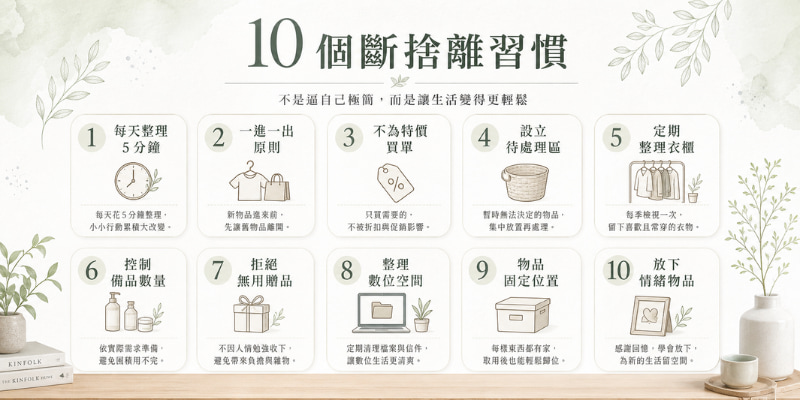
10 Quick Organizing Habits for Decluttering
| decluttering habit | Situations you might encounter | How can I begin? |
|---|---|---|
Tidy up for 5 minutes every day | My desk and bedside are messy every day, but I don't have the energy to do a thorough tidying. | Before bed, tidy up only a small area, such as clothes on your desk or chair. |
One-in-one-out principle | I'm buying more and more clothes, cups, and skincare products. | Before buying a new one, get rid of the old one first. |
Not buying for special offers | I often buy more things to get free shipping and discounts. | I'll put it in my cart for a day, and then I'll want to buy it again the next day. |
Set up a pending processing area | There are some things I can't bear to throw away, but I don't know whether I should keep them or not. | Put it in the box, and reassess it if it's not used for 30 days. |
Organize your wardrobe regularly | I have lots of clothes, but I feel like I have nothing to wear every day. | Keep the clothes that are comfortable and fit you now. |
Control the quantity of spare parts | Shampoo, toilet paper, and cleaning products are piling up. | Each type of supply item has a fixed space; once it's full, don't buy any more. |
Reject useless free gifts | The drawer was filled with small items, samples, and eco-friendly bags. | Don't bring home things you don't know how to use. |
Organize digital space | Mobile phone photos, screenshots, and apps are becoming increasingly common. | Delete screenshots, duplicate photos, and infrequently used apps once a week. |
Fixed position of items | I'm looking for keys, scissors, and charging cables every day. | Frequently used items are stored in designated locations and put back after use. |
Practice letting go of emotional objects | Old cards, souvenirs, and gifts are hard to throw away. | Keep a few of the most representative items; the rest can be photographed and saved. |
(The mobile version of the table can be swiped left and right)
1. Spend only 5 minutes tidying up each day; don't wait until your room is in complete disarray before you start.
The most common reason for failure in tidying is not because you don't want to tidy, but because you try to tidy up too much at the beginning. Many people think that they will tidy up when they have time on the weekend, but when the weekend comes, they feel too tired and don't want to do anything. In the end, the room is still messy, the desk is still piled up, and clothes are still hanging on the back of the chair. As the mess grows, tidying is no longer a small thing, but a very stressful project. So, instead of demanding that you tidy up all at once, it is better to start with 5 minutes a day.
These 5 minutes don't have to be grand. It can be as simple as taking the cups off the table to wash, hanging the coat on the chair back in the closet, throwing away the receipts by the bed, and coiling up the charging cables. You don't need to become a master of organization overnight. Just make sure things don't get out of control. The worst thing about decluttering isn't being slow, but rather accumulating things over time. Clear a little bit each day, and life won't become so chaotic that you don't want to face it.
2. Develop the "one in, one out" principle to avoid buying more and more things.
Home space is limited, but if things only go in and never out, they will eventually fill up, especially clothes, cups, skincare products, and storage boxes. They may not seem big, and they may all seem useful, but after buying them for a while, you will find that the cabinets are getting fuller and fuller, and the drawers are getting harder and harder to close. In reality, you only use a few things every day.
"One in, one out" is a simple yet effective habit. When buying a new piece of clothing, get rid of an item you haven't worn in a long time; when buying a new cup, think about whether you have a cup you rarely use; before buying new skincare products, finish the ones you already have instead of constantly opening new ones. This method doesn't mean you can't buy things, but rather that each purchase becomes more meaningful. When you know that something new is coming in, it means something old is leaving, and you'll be more discerning in judging whether something truly deserves its place.
.jpg)
3. Don't buy just because it's cheap, on sale, or has free shipping.
Many miscellaneous items appear not because they are truly needed, but because "it happened to be on sale," "buying another one would be more cost-effective," or "I almost got free shipping." At the time of purchase, you might feel smart, as if you've saved money, but after a while, you might find that those little things you bought to qualify for free shipping were hardly ever used; that discounted piece of clothing turned out to be difficult to style; and that set of storage items that seemed like a good deal eventually became new clutter.
Ask yourself three things before you buy:
- Would I still buy it if it weren't on sale? (To avoid being solely attracted by discounts)
- Do I already have something similar at home? (To avoid duplicate purchases)
- Will I need this item this week? (To avoid it becoming just another "maybe I'll use it later" item)
If the answers are all vague, it's usually okay not to buy it right away. Often, if you check again after a day, you'll find that you don't actually need it that much.
.jpg)
4. Set up a "pending area" and don't force yourself to make decisions immediately.
Not everything can be decided immediately. There are some things that you really hesitate about, such as gifts from friends, souvenirs from past trips, or small items that you used to like but no longer need. Throwing them away directly seems too harsh, but keeping them feels like they take up space. In these situations, you don't need to force yourself to make a decision right away.
You can prepare a "to-do area," such as a box, a drawer, or a small compartment in a cabinet, to put items you're unsure whether to keep or discard. Then give yourself a deadline, such as 30 days or 3 months. If you haven't used or thought about it at all during this time, it means it's probably not that important to your current life. Deciding whether to donate, transfer, or recycle it at this point will usually be much less psychologically burdensome. Decluttering isn't about becoming cold-blooded; it's about giving yourself a buffer period to gradually determine which things you truly need to keep.
.jpg)
5. Regularly organize your wardrobe, keeping only clothes you'll actually wear right now.
The wardrobe is the place where illusions are most easily created. Even though you have a lot of clothes, you feel like you have nothing to wear every day. The reason is usually not that you don't have enough clothes, but that you have too many clothes that "you will never wear now." Some clothes don't fit, but you think you'll wear them when you lose weight; some clothes you no longer like in style, but you still think they're new; some clothes you used to wear often, but now they just don't feel right. These clothes may look wearable, but they're actually no longer suitable for you now.
Before organizing your wardrobe, ask yourself:
- Have I worn it in the past year? (To determine if it will actually be used)
- Do I feel comfortable wearing it? (Assess whether it suits my current physical condition)
- Does it fit my current life? (Assess whether it still suits your work, daily routine, and style)
- If I saw it in the store today, would I still buy it? (To determine if I'm keeping it only because I already own it)
.jpg)
6. Avoid overstocking supplies; keep only the right amount.
It's not that you can't buy supplies, the real problem is that you hoard them until you forget what you have at home. Many people don't lack shampoo, but they already have three unopened bottles in their bathroom cabinet. They don't lack toilet paper, but they always buy a bunch when it's on sale. They don't lack cleaning supplies, but they have a bottle in the kitchen, on the balcony, and in the pantry. In the end, they don't even know which ones to buy first or which ones are about to expire.
Stockpiling initially provides peace of mind, but excessive stockpiling can become a space constraint. A better approach is to assign a fixed place to each type of item. For example, toilet paper should only be stored in a specific cabinet, and shampoo and body wash should only be kept in the same storage basket. Once that space is full, avoid buying more. Space itself serves as a reminder; when you can see, reach, and know how much you have, you're less likely to repeatedly buy the same items.
7. Learn to refuse unnecessary free gifts and trinkets.
Some things aren't bought, but rather "taken home on the spur of the moment"—pens given away at exhibitions, samples from department stores, small gifts from events, free eco-friendly bags, brand gifts, small cups given away with purchases. At the time, you might feel it's a shame not to take them, but once you get home, they often just end up in a drawer and are never taken out again.
A crucial step in decluttering is preventing unnecessary items from entering your home. If you know you won't use something, you can refuse it from the start. This isn't wasteful or unappreciative; it simply means you understand your space is limited and don't need to bring home something else you'll have to declutter later. Many people only realize at the end of decluttering that what truly makes their home cluttered isn't necessarily large items, but rather those seemingly unimportant but accumulated small things.
8. Organize your phone, computer, and digital storage.
Decluttering doesn't just happen at home; it also happens on phones and computers. There are thousands of photos in a phone's album, most of which may be screenshots, duplicates, or blurry photos. There are also pictures that you thought you should keep but never looked at again. The same goes for computer desktops. Files are saved one after another, and when you need to find the information, you don't even know where it is.
Although digital space doesn't take up physical space, it can capture your attention. You can spend 10 minutes each week organizing your phone or computer. You don't need to organize everything at once; just start with the easiest part.
- Phone photos : Delete duplicate photos, blurry photos, and useless screenshots.
- APP : Remove apps that haven't been opened for more than 3 months
- Email : Unsubscribe from unread newsletters
- Computer desktop : Organize files into folders, don't pile them all on the desktop.
- Cloud Drive : Regularly deletes expired versions and duplicate files.
9. Every frequently used item should have a designated place.
Some frustrations aren't caused by major events, but rather by the accumulation of small things that happen every day: not being able to find your keys before leaving the house, not being able to find scissors when you want to cut something, not being able to find your charging cable when your phone is about to die, and not being able to find the tape you have at home every time you need it. These things seem small, but when they happen repeatedly every day, they can make life very difficult.
Often, a messy home isn't necessarily because there's too much stuff, but because things don't have a designated place. Frequently used items should always have their own spot: keys should always be in the entryway, scissors in the same drawer, charging cables by the bed or desk, and receipts in a small box. The placement doesn't need to be fancy; the key is knowing where to find them every time. Once you have everything organized, tidying up becomes much easier. Putting things back after use is a simple act, but it's arguably the most important habit for maintaining cleanliness.
10. Practice letting go of emotional possessions; not every memory needs to be preserved through objects.
The hardest things to let go of are usually not things that are no longer useful, but things that hold sentimental value: old cards, souvenirs, travel ticket stubs, old gifts, and children's childhood artwork. The reason these things are hard to throw away is because they have a story behind them. You're not reluctant to part with the piece of paper or the trinkets, but rather with the period of time they represent.
Therefore, when faced with emotionally charged items, don't force yourself to throw them all away at once; that will only make you more resistant to tidying up. You can start by selecting a few of the most representative items to keep, and preserve the rest by taking photos. You can also prepare a special box for these memory items, but limit its size. When the box is full, it means you need to re-select which memories are most worth keeping. Keeping items doesn't mean keeping memories; throwing away items doesn't mean denying the past. What you really want to practice in decluttering isn't becoming heartless, but learning to say goodbye to the past in a gentler way.
Decluttering isn't about throwing things away, but about getting rid of these four burdens.
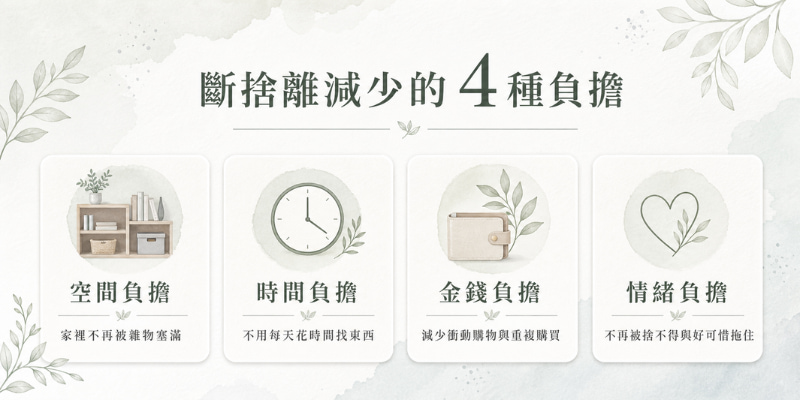
- Space burden : No more clutter in the home, making movement, storage, and cleaning easier.
- Time commitment : No need to search for things every day, and organizing won't become a huge project.
- Financial burden : Reduce impulse buying, repeat purchases, and reckless buying for discounts.
- Emotional burden : No longer constantly held back by "I can't bear to part with it," "What a pity," and "I'll need it later."
Many people think that decluttering is just about making your home cleaner, but the real difference is that life becomes easier to manage. You don't have to spend a lot of effort fighting against chaos every day, nor do you have to constantly search for what you really need among a pile of items.
FAQ: Common Questions about Decluttering
Q1: Does decluttering necessarily mean throwing away a lot of things?
Not necessarily. Decluttering isn't about who throws away the most things, but about whether what you keep is suitable for your current lifestyle. If you use something often, like it, and feel comfortable looking at it, then it has a reason to stay. Don't declutter for the sake of decluttering; that will only make organizing more stressful.
Q2: The items are all new, wouldn't it be a waste to throw them away?
It's normal to feel this way, especially with items you've only bought a few times or haven't even opened yet; it really feels like a waste to throw them away. But you can handle them differently; you don't have to throw them away directly. You can give them to someone in need, donate them, sell them secondhand, or put them on an exchange group. The real waste isn't letting things leave you, but having them sitting in your house unused.
Q3: How often should I declutter?
Ideally, you should do small tidying sessions every day, followed by larger tidying sessions periodically. For example, spend 5 minutes each day tidying your desk, bedside, or entryway; organize your supplies and documents monthly; and tidy your wardrobe quarterly. This way, it won't accumulate into a huge undertaking. Decluttering doesn't need to be drastic; the key is to make it a natural habit in your life.
Q4: What if my family members don't cooperate with my decluttering process?
Start with your own belongings. Don't expect your family to change right away. Many people, when tidying up, want to help their family members throw things away as well, but this can easily cause a backlash because everyone has different feelings about things. What you consider useless might be useful to someone else. A better approach is to tidy up your own space first. When your family members genuinely feel that the space has become cleaner, it's easier to find things, and cleaning is easier, they are more likely to gradually accept the change.
Q5: What should I do if I really don't want to throw things away?
Don't rush to force yourself to throw things away. You can put the things you can't bear to part with into a "to-do box" and set a deadline, such as 30 days or 3 months. When the time is up, open it and take a look. If you haven't thought about it at all and don't need to use it, it's usually easier to make a decision. Decluttering isn't about becoming decisive immediately, but about gradually practicing distinguishing: what things I truly cherish, and what things I'm just not ready to let go of yet.
Conclusion: In the end, decluttering doesn't make your home feel emptier, but rather makes you feel lighter.
The hardest part of decluttering is never actually "throwing things away." The real challenge is admitting that some things are no longer suitable for you. That piece of clothing you bought but rarely wear, that little item you always thought you'd use someday, those souvenirs you can't bear to throw away but haven't opened in a long time—they may just be sitting in a closet, but sometimes they're like reminders of past choices, past relationships, and the version of yourself you couldn't let go of.
Therefore, decluttering isn't about making your home look like a showroom, nor is it about living a minimalist life. It's more like a slow process that allows you to re-evaluate as you organize your things: Do I really need these things right now? When you're willing to start tidying up from a drawer, a wardrobe, or a corner you find annoying every day, you'll gradually discover that life doesn't actually need to be supported by a lot of things. A cleaner desktop makes you feel lighter; fewer wardrobes make it easier to get out of bed; and more free space in your home gives you more room to rest.
What truly remains after decluttering is not just a neat space, but a clearer sense of life. You know what's worth keeping and what you can let go of. In the end, you're not just organizing your home, but gradually adjusting your life back to a comfortable state.
(This article is the property of Dauriac and may not be reproduced with images or text.)
You may be interested

Recommended topics
Top Charts
All articles
article keywords
Subscribe to newsletter
article outline